
In the year 2009, on November 8th, Saturday, the Italian public broadcasting company (RAI) issued a broadcast with the Italian journalist Lucia Annunziata interviewing US movie-director Michael Moore inside her specialist program “In mezz’ora”1.
The interview was interesting, but what mainly struck me was a specific reflection of Michael Moore about his own work. About his last (in those times) movie, “Capitalism, a love story”, he said that the final passage at the end of it wouldn’t mean he was thinking about abandoning cinema; however, the question he was reflecting about is that a new movie couldn’t have any sense if one could not find any track of some effects of the formers on the people.
Why did it strike me? Because it was the first time I was hearing someone engaged in social criticism reflecting on the meanings of his own work2. In Italy, social criticism seems being practised by a lot of people, not only scholars: journalists are highly present in the list. Italian libraries display an overload of books on this subject, and Italian broadcasting companies (not only RAI, see Note 1) are full of specialist programs dedicated to the topic. In such scenario, it is usual to hear comments like these: “Since twenty years I am denouncing such thing and nothing has changed up until now…”; “I said this thousands of times to the accounts, and nothing happened…”.
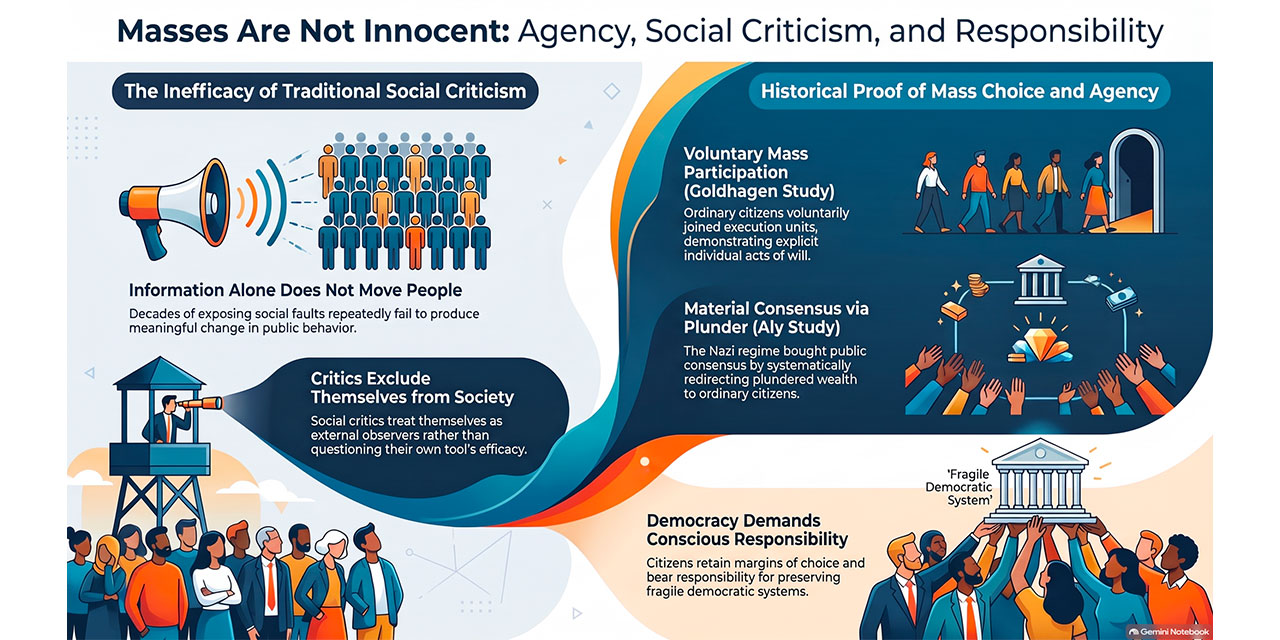
Evidently, these comments are stated assuming a special point of view: one which excludes from the context of the society under critic the social critic herself. I mean: if you, social critics, are engaged in scrutinizing your own society (the society you live into) with the supposed objective of contributing to make it better, you cannot avoid a reflection about the efficacy of your work. You cannot restrict your point of view to an external position with respect to the society you are investigating, because you belong to it; and if you are in, the position of the pure observer is not coherent, cannot be allowed. For example, considering the comments I reminded here above: if you have been insisting for twenty years in denouncing some social faults, and nothing changed, you must become conscious that something about your denouncing was wrong, or has gone wrong. If you have gone on with thousands of suggestions to the accounts, and nothing happened, you must raise doubts on the same instrument you are using3.
The reason of this may be independent of the responsibilities of social critics: maybe inefficacy depends on the type of instruments employed; or it can depend on the wrong way an effective tool is used; or it can depend on the general conditions of the society, which prevent an effective use of the same tool. Anyway, if it doesn’t work, you have to take on the problem and analyse your own instruments, too. You cannot just continue going on “denouncing” (what and for what?).
If people won’t move, social criticism should be recognized as not effective, and we should be forced to seek new instruments. I have tackled such subject in something I wrote several years ago about Italian situation4. Italian political and social structures are periodically (and frequently also) ravaged by scandals of any kind; such trend does not seem to go to an end (at least to a close end). Such scandals are not only well known (they are “public” in a literal sense), but are scrutinized and deepened by a great amount of books, printed articles and broadcasts by all the Italian broadcasting companies. And even dedicated movies. Many films have been dedicated to some of the most upsetting events like, for example, the assassination of police officers, magistrates and witnesses in the long war of Italian State against organized crime5. The works about these events have had a very large diffusion, but things do not seem to have changed in force of such spread; what led me to think that in Italy “everything is known while nothing seems to change”.
The general impression is that they who are drawn by such information are mainly people who are already sensitive about the subject and prone to a moral position of condemnation. In other words, these works do not collect proselytes among those who should need to be informed, do not raise interest among those who should need to become aware of the problems; they have an impact only on they who are already informed and aware. As it seems, information alone cannot move people. What leads me to a further step: conversely, people that don’t move does so because they choose to remain inactive? And what does such choice exactly mean? This is a different, wider question: why denouncing defects and faults of our societies continues to have no effects? And, in the end, on who the responsibility of this carelessness falls on?
It is worth enlarging our vision and introduce “masses”: the mass. From a little country town to the megalopolis, from a rural community to an entire nation, the individuals gathered in those environments are not just single individuals: they belong to a population, they share a language and a culture, they are parts of a social system. They are parts of a mass. What’s the role of these masses in society and in history? The individuals who compose the mass are just spectators or are they protagonists? And what does this mean, exactly?
Scientific literature tends to tackle such subject oscillating between social psychology (social side) and clinical psychology (personal side); however, the connections between these two aspects remain obscure. How can individual behaviours (subjective, single behaviours) reflect on the behaviours of masses? And, conversely, how can masses slants influence and condition individual behaviours? I think that, at the moment, we do not know. However, we have evidence that this happens: we have seen and heard recordings of the mass-meetings of Nazi enthusiastic supporters in Nuremberg in the thirties of XX Century. And the individuals that composed those masses were certainly different to one-another. All the same, they shared something in their emotional state; what and why? Was it there, inside such state, a component of choice? And what, exactly, does it mean?
About things of such kind, we can say that what is certain is that individual and masses behaviours are linked in a very complex way, with individuals impulses and drives mixed with ideal slants, concrete interests, personal characters, and many other things. It is impossible to disentangle such an intricate system; the effect is produced by an entire set of reasons which cannot be picked up separately. In the end, it is the entire human being that reacts. However, some recent historic studies have shed some light on the obscure link between individuals and masses behaviours and on the question of choice.
Daniel Jonah Goldhagen is a US historian who, in 1996, wrote “Hitler’s willing executioners”6. He tackled the question of the Holocaust from a non-traditional slant. He did not focus on the institutions which decided the “final solution” and the organizations which tried to realize it: he focuses on a component usually overlooked by history, the executioners. He starts with a quasi-trivial observation about massacre: it is not an ordinary thing, it is something exceptional. Even the chief of SS, Himmler, who wanted to watch such an event in the east front of war, collapsed. Massacre is something exceptional, but the executioners were not fanatic and hot-headed SS militiamen, but ordinary German people. They were members of land police corps, and among them a young officer is described who went to lead a unit of executioners with his wife (in occasion of their honeymoon!) and his dog. These people had voluntarily joined such units, making a clear act of will; and they executed all the Jews they met.
Goldhagen confutes, with profound argumentations, the five different theories which have been proposed up until now to explain the unexplainable: how was this possible? Goldhagen proposes a new theory: Hitler’s success was due to the fact that he did not “create” antisemitism in German minds; he understood his people and intercepted an impulse that was already present in Germany from medieval times. Such impulse was a specific form of antisemitism: a form oriented to the physical destruction, the “elimination” of Jewish people. We cannot yet understand what moved any single participant to the massacre, but we have the evidence that a lot of people participated and willingly acted in it. From another source I learned that was quite usual, in certain units in the eastern front during the Russia campaign, to see soldiers, in occasion of some pauses in their duties, taking their camera and go for some “horror tours” and get “souvenirs”.
Another historian (and also a journalist and a political scientist), a German one, Götz Aly, wrote, in 2008, the book “Hitler’s beneficiaries: plunder, racial war, and the Nazi welfare state”7. Aly examines in detail the economy of Third Reich and comes to an unedited conclusion: the twelve years of Nazism in Germany have been, beyond other things, a systematic drawing of resources toward the German population, in part from the same German industries and in part from the plunder of Jewish people wealth. He notes that pensions and retirement benefits have gone on (also increasing) up until the year of the defeat, 1945. It is impossible to avoid the thought that Hitler, apart having fascinated German people, had also “bought” their consensus. Some historians of the mainstream historical research disagree with his point of view, and argument against his “economic reductionism” and the emphasis (an exaggerated emphasis) on the material factors, while Nazism was, at its core, fundamentally irrational8. Maybe; however, notwithstanding the complexity of the process that leads an individual to a decision (a process influenced and driven by many factors), the fact remains that we should consider among such factors even the personal, material interests of the protagonists.
The point of view proposed by these two historians is interesting under another profile: it arises through studying details, in philosophical terms “phenomenology”. Without entering a philosophical discussion about it, we can synthesise the meaning of phenomenology in “what happens how it happens”. Things as they exactly happen, in the materiality of the involved subjects and of the details of the events.
Such approach opposes to a traditional scientific literature which inclines to see mass behaviour as, on the one one hand, incomprehensible because of its complexity; on the other hand, governed by deterministic laws, monolithic, shapeless. Just two examples about determinism, the first of which is referred to Karl Marx: he was able to see the processes and the main characteristics of capitalism; however, his vision of the future evolution of societies was deterministic, mechanic. Given that the deep problem is founded on the ownership of economic means of production, once that such ownership is transferred from capitalists to the people, the question is solved. History did not confirm such prevision9.
The second example comes from the work of Barbara Ehrenreich on the conditions of life of US low-wage workers (see Note 2). The opinion she drew from her social experiment10 is that the poor who accept those works and don’t try to fight against their actual conditions, do so in force of the overwhelming constrictions of the environment: they must employ all the time they have in order to try to earn a salary sufficient for surviving. They cannot study, they have no time to amuse some way, they cannot fight because they are scared by the possible retaliations by the enterprise they work for. They adapt to their present conditions because they have no diverse chance.
Masses as spectators of history? Ready to raise up just to follow a demagogue who promises simple solutions for complex problems? I do not think the answer is so easy, and the two works I chose for my comment give us some hints. To pose the question directly and brutally: they mean that German people, given the choice of its majority, can be considered guilty for the Holocaust and the other atrocities of Nazism? Obviously, absolutely NO! The question of collective responsibility has been widely posed and discussed after World War II; I do not know if it had a definitive answer in philosophy11, but for me as an ordinary citizen of a modern democracy the answer is clear. I have also written something about this in my personal reflections online (see Note 4). Responsibility can be only individual because individual and mass level are structurally different, and the faults of an individual, or of a sub-group, can never be spread over an entire population. This is actually true for Germany, even in the Nazi Era12: there were opponents, in Nazi Germany, and the case of Hans and Sophie Scholl is just one among many13; as there were informers and traitors among Germans, as the one who denounced them.
The individual level (the one to which the concept of responsibility applies) must be kept separate and independent from the collective level. So, in the end: what can we conclude about the initial question I posed? Masses choose or are just reactors (mechanical reactors) to the stimuli they receive? What I exposed clearly provides hints that an important component of choice is present in masses behaviours; we cannot say (and probably we will never able to say) in which amount some component plays its role, but certainly it does exist and is present. As much as to say: masses are responsible, they are not innocent.
And I feel the necessity to be extremely clear about responsibility: responsibility is not just a question of personal choice; it depends on circumstances, on the actual context. If you are passing in a place in which an unpredictable event happens under your sight (a street car accident, for example), such event transforms your role. You are no more a simple passer-by, you are at least a witness. Then, you can decide to give your testimony or not, but you have to consciously decide it in your new role of witness. So, masses are responsible, they are not innocent, just in force of their belonging to a modern democracy (I leave apart, for the moment, the case of those who live inside non-democratic nations14).
Because democracy is never given: it lays on people and on the choices of the people.
It is not a question of reclaiming acts of heroism by every single citizen; it is just a question of living consciously and do one’s own part, even when in difficulty, in order to preserve this fragile common good: democracy. This is the duty of each one ordinary people on the scene. It cannot be expected by everyone; it suffices a reasonable mass of right behaviours.
1 The title literal translation is: “In half an hour”. It was (and still is) issued by Italian public broadcast company RAI.
2 I borrowed the expression “social criticism” from USA language. People engaged in criticising social habits and established social rules are present in every historical age; I refer, here, mainly to those thinkers (historians, philosophers, sociologists and so on) who worked in XX Century (after World War II) like Vance Packard (author of The hidden persuaders, New York, David MacKay Company, 1957), Christopher Lasch (for example The minimal self, New York, Norton, 1984) or Barbara Ehrenreich (for example Nickel and dimed – On (not) getting by in America, New York, Henry Holt & Company, 2001).
3 That’s why Karl Marx reproached past times scholars and some of his opponents: they had taken capitalism as something given, without considering history and social contexts. On the contrary, his contribution was at first focusing on capitalism and “scientifically” analyse it in its intimate processes.
4 Reflections present on my website, https://www.robertomaffei.it/articles.php, just a personal small repository (in Italian language) of some thoughts of mine.
5 Some random examples: the assassination of General Carlo Alberto Dalla Chiesa (killed with his wife and a police officer as body guard), the assassination of judge Rosario Livatino (who knew to be in danger and travelled without protection to avoid involving others), and the famous case of Lea Garofalo, “witness of justice”.
6 Daniel Jonah Goldhagen, 1996, Hitler’s willing executioners, New York, Alfred A. Knopf.
7 Götz Haydar Aly, 2008, Hitler’s beneficiaries: plunder, racial war, and the Nazi welfare state, New York, Metropolitan Books / Henry Holt & Co. This is the English version, the original work is in German.
8 For a brief review about this: https://en.wikipedia.org/wiki/G%C3%B6tz_Aly .
9 For example, the few cases in which such transferring really was tried (think to Russia and China) were in conditions very different from what Marx anticipated; and they did not solve capitalism problems as foreseen. But this cannot be deepened here.
10 See, in particular, the final chapter, dedicated to an assessing of her whole experience.
11 A famous German philosopher, in the years immediately following the war, dedicated a book to the question: Karl Jaspers, 1947, The Question of German Guilt, New York, Dial Press.
12 I chose the Nazi phenomenon because it is well known and documented, but every nation of this World of ours has something (better: many things) to be ashamed of in its past, and even in its present.
13 See, for example, Joachim Fest, 2012, Not Me: Memoirs of a German Childhood, London, Atlantic Books.
14 Anyway, maybe context conditions are prohibitive, but actual experience shows that quite always some margins of choice, even though minimal, do exist. See, for example, Bruno Bettelheim, 1960, The Informed Heart: Autonomy in a Mass Age, New York, The Free Press, Glencoe, III.